
The West Wing – Underrated (Don’t @ Me)
It’s very hard to remember yourself in the past. One of the hardest things, I think, to do when self-reflecting is to ‘un-remember’ things. Once a piece of information or an experience enters our brains, that impacts us, our minds have a way of operating as though we always had that information. Even knowing this, we can think back to what our thought process was when we, say, jumped off that roof, or wrecked into that parked car, or ate that Tide Pod. But a residual part of the things we’ve been through since then will always be there without a Herculean effort to erase it. This is, obviously, a problem today. Almost every conversation of our country’s history is plagued by a revisionist insisting that “people should’ve known better” when there’s no good gal darn reason why they should, or could!
It is this phenomena that makes it hard to overstate the quality of The West Wing; one of my favorite shows of all time(yes, despite the ideological message). What Aaron Sorkin was able to do by borrowing elements of traditional “procedurals” and telling stories of weight and substance, centered around the heart and soul of a country had a profound impact on me. If ever I’m running short on things to watch, and have some time, A West Wing binge-watch is always an enticing option.
And with this show, the question of, exactly, how we gauge the quality of a piece of art comes into question as well. Whether art is characterized by what it’s impact on an audience is, or simply that it impacted an audience. This type of debate tends to drive me crazy, with one school of thought suggesting that whether the motivation or impact of the art is negative or positive does not matter, and it is merely it’s effectiveness that matters, while the other side would hold that the art must result in something good for it to be considered good. I, generally, would come down on the side of the 1st stance, but it always feels like, 1. The people arguing that side forget what they’re arguing and start to conflate ‘good art’ with ‘morally good’ and 2. Measuring the scope of a work’s impact can be quite difficult and therefore render the entire exercise moot. For instance the “It must be good art, because look at all the reaction that it is getting,” statement aggravates me. Because, often times, the people making this claim are actually trying to say, “It must be morally good, because look at all the reaction to it,” which I find somewhat silly. And then, of course, we have the question of “all these people.” The amount of people that react to a thing is hard to gauge in the era of the internet, and can, very often, be manipulated. It’s amazing how 5 anonymous reactions on Twitter can turn into an “attack” or a “trend.”
The reason I wasted so much of your time with that last paragraph is because the sentiment applies to more than judging a piece of art. I have seen it leak into the church in regards to current political movements as well. We don’t have that kind of time, right now, but suffice it to say that our perceptions of quality and competence can cause quite a lot of conflict.
Maybe it’s better, then, to simply talk about a TV show’s success as a measuring stick, for simplicity sake. And perhaps the most impressive indicator of The West Wing’s success, is the fact that (as far as I can tell) never had such a high-stakes political drama existed before it, and none have come close to matching it today; 22 years after it’s initial release. Granted, I am not old enough to have a firm grasp of the television landscape at the time of its release, but a cursory search of shows in the same vein from that time period comes up pretty bare. This coupled with the fact that my first real viewing of the show came 7 years after it’s final season, and still ranks as the best political drama I’ve ever seen, has got to mean something. As my memory goes, politicians had most often been portrayed in TV with either a comedic bent or benevolent public servants, without a great deal of focus on the nuts and bolts. The fact that the show has remained so popular long after it’s exit from the prime time-slot on NBC would suggest that, at least for one group of art critics, the show is a masterpiece.
Now, in terms of the second group of critics; the ones who think art must have a good or positive effect, this show would be in questionable territory. On one hand, the number of people that seem to take the show as truth; imaging this show as political gospel, imagining themselves as certain characters, their party as the clear-cut good guys, and even mistakenly forgetting that Martin Sheen, in fact, was never president of the United States, the impact has been negative. On the other hand, for those whose take away came from their occasional patriotic message of ‘country over party’ and the virtue of bi-partisans politics, the impact could be viewed as positive(if you’re in to those kinds of things).
As far as my own stance goes; I think it was an amazing television show, whose compelling story-telling and production actually had a negative impact on the country, today. They were so good at doing what they did that many people mistakenly ascribed virtue to the show and elevated it outside of the realm of entertainment. This is not uncommon, and I think people with a conservative orientation are usually more capable of separating art from artist, largely, due to shows like this. I have no trouble calling this one of my favorite shows ever whilst also disagreeing with most if not all of the motivations of the characters, and the messages the show delivers. Of course, that’s a conversation for another time. Let’s get to the show.
The Flavor
Probably, the most common memory that comes to peoples’ minds about the show’s structure is the signature “walking and talking” that they do. To derive one’s knowledge of the executive branch of government from this show would lead us to believe that the White House is an endless maze of hallways in which all of the nation’s biggest decisions are made. Not in the meetings that they are headed to, but on the trips to and from those meetings; winding around every corner and through every doorway. This approach to the show, in combination with the quick-witted dialogue, gives the show a heightened sense of pace that kept me drawn in. It almost comes off as symbolic in how it executes its exposition dumps for the audience. It does them in a satisfying way that assures you it is going somewhere, and it does it visually with these “walking and talking” scenes throughout the show. They also serve as a sense of build-up for the show. Viewers know that once they reach a closed door, or experience any disruption to the rhythms of their literal paces, something important is about to happen. And the effectiveness of this device could not have been possible without the aforementioned ‘quick-witted’ dialogue.
In addition to the pace is the very 90s feel of the production. The score of this show adds about 20% to it’s enjoyment. I don’t think it would be a stretch to say that the show’s production could be mistaken for a Steven Spielberg production without the action. It’s got the same “lived-in” feel of many of his projects (many from the 80s and 90s in general) at a time when many TV shows were starting to go with the sterile “hospital room” type feel. From the first rump-bum-bump of the snare drum in the opening credits, to the playful orchestra sounds during the moments of levity and the intensity that accompanies the moments of tension, you’d be hard pressed to find any production that utilizes their musical accompaniment better.
Where the ER-type pacing and amazing orchestra work certainly leaves an impression, the dialogue would probably be, in my opinion, where most people find their favorite parts of the show (as with all dramas). One’s enjoyment of the show is inextricably linked to their ability to keep up. And, for the most part, the writers did an excellent job of keeping audiences at the upper limits of that ability. We understand that the quips and comebacks and reactions, in real life, would not operate at this pace, but we don’t care, and the humor is of a certain type that requires the fast-paced delivery to work. Whereas so many other types of comedy require to obligatory ‘breathing period’ —
Side Note: I just want to reiterate my appreciation for this type of delivery. A criticism that I often see levied against comedy is in how humor isn’t given the chance to “breath.” As is often the case, this is not a hard and fast rule. Not all comedy needs to breath and a lot is way better when given in bursts. We’ve taken this sentiment way too far and it seems to be getting worse. I can’t count the number of times I’ve been sucked out of a show or movie by creators that deliver a joke and then spend the next 5 minutes telling you to look at the joke. I’m not saying it can’t work at all, it can, but it has always been a risky endeavor with a high chance of backfire if not used very sparingly and very carefully. Today, it seems as if some shows lean exclusively on the dragging out of a joke indefinitely; thinking that it’s the practice, itself, that people find funny, and that the content of the joke doesn’t matter. Wrong!
Anyway, the banter in The West Wing remains the standard to which all other shows are held to for me; particularly, that of Josiah Bartlet. Which brings us to the cast.
The Cast
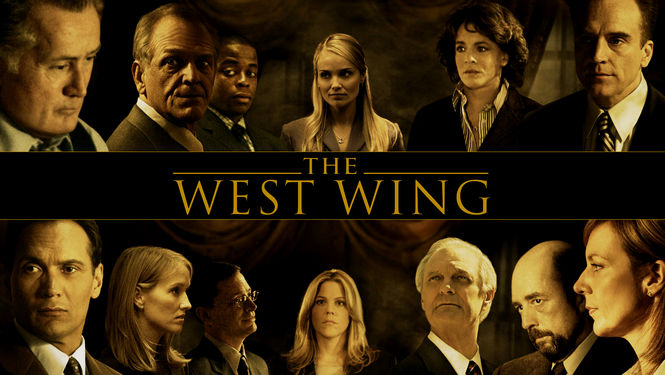
I don’t intend to get into the ‘inside baseball’ details of contract disputes and the downgrade in quality once certain members, including Sorkin himself, left the show. They’re all worth discussing, and the show certainly suffered for it. But I just want to comment, briefly, on the quality of the original cast. A common exercise for fans of shows is to identify the best character in the show and defend that choice. It would be an easy assignment for any member of the original cast. Among the choices, I would include:
Josiah Bartlet – The President [Martin Sheen]
Abigail Bartlet – The First Lady [Stockard Channing]
C.J Cregg – The Press Secretary [Allison Janney]
Leo McGarry – The Chief-Of- Staff [John Spencer]
Josh Lymon – The Deputy Chief-Of-Staff [Bradley Whitford]
Donna Moss – The Assistant to the Deputy Chief-Of-Staff [Janel Moloney]
Toby Ziegler – The Communications Director [Richard Schiff]
Sam Seaborn – The Deputy Communications Director [Rob Lowe]
Charlie Young – The Personal Aide To The President [Dule Hill]
(Not a complete list of characters, only the viable candidates for MVP)
With so many main-stays on the show, it would be easy to get bogged down in the altering of plots to allocate screen-time or the artificial elevation of different characters to the detriment of the show. And, while this may have very well have gone on, they handle it as well as any show ever has(at least in the first couple seasons). I suspect that most fans of the show would choose President Bartlet as their fighter(myself included), but there are no wrong answers on this test. Each character carried their own personality and motivations. And the chemistry just seemed to work.
It would be easy, today, to make the mistake of assuming that none of these actors (excluding Martin Sheen and Rob Lowe) were very well-known, but that would be big-screen bias. Truth is, for a television show in 1999, the cast would probably be considered one of the more well-known casts at the time. While the show certainly did wonders to cement the careers of all of its members, particularly Bradley Whitford, Richard Schiff, and Allison Janney(these 3 being, arguably, the show’s heart), there was a great deal of experience on the set. Acknowledging that the show can clearly be credited with the launching of Dule Hill and Elisabeth Moss’s career, even they had several years of TV experience(albeit relatively unknown) under their belts at the time. Of course, there was a much more pronounced line between TV and movie actors at the time, but it’s impossible to miss the great deal of professionalism on display at the outset.
Perhaps the undoing of the show(if you ask me) came with the changes to this original cast. As I often tell friends, the arrival of Will Bailey was the death knell for me. While I harbor no ill will for the actor that portrayed the character, I found him to be, maybe, the most unlikeable character in the history of TV or cinema. While the show certainly excelled despite him, for 2 seasons, the decision to choose him as Rob Lowe’s replacement, and then to elevate his profile in the show, was a blunder in my humble opinion. In fact, pretty much every main character that was cycled in, save for Emily Proctor(whom they lost to CSI), kind of failed for me. The addition of Amy Gardner(played by Mary-Louise Parker) and Kate Harper(played by Mary McCormack) felt forced and bogged down the show as well. Even the presence of Alan Alda and Jimmy Smits did little to salvage the last two seasons of the show(and we don’t talk about those 2 seasons). Which goes to show just how valuable Sorkin was to the production.
The Story
As far as the show’s premise, it was rather simple; the day-to-day life of a president and his staff as they govern in the years 1999-2006. The primary focus of the show was on the communications department, and we are led to believe that this particular group is where all of the important decisions are made. A notion that was often taken at face value, it occurred to me, after my second viewing, that by focusing the show on those responsible for ‘crafting a narrative’ we are given a more cynical view of the business of governing. While I don’t doubt the reality of this being one of the central concerns of today’s executive branch, I can’t help but feel as though it played a more outsized role in the show than in many real-life administrations(there I go, conflating real life with television).
Every event that took place was immediately dissected for its political implications, thrown into the spin machine to determine the most advantageous posturing, and tied to some partisan cause in the hopes of advancing an agenda. Solving the problem often came secondary. The show did well to acknowledge that fact and, often, vocalized the moral conflict while trying, always, to maintain the humanity of the characters(a part they forget today). We are treated to all of the political issues of the time, and from one side of the aisle. If nothing else, we are given a detailed view of exactly how members of the Democrat party viewed their leaders and the opposition. I think this type of thing today would mistakenly be assumed as a negative to studio execs, and a good way to “cut your potential audience in half,” so to speak. However, I’ve always felt that the biggest issue most people have is not with the partisan nature of things (look around), but with the deception. A show ABOUT politics avoids the criticisms that other shows do not.
By focusing on a Democrat administration, the show identified itself and declared to audiences “this is how we see it.” This does not, automatically, exclude members of the other party, it actually gives you cover. Whether or not the other side finds a depiction to be accurate has little to do with the entertainment value of the story. There must be truth in the characters but, just like the world of fantasy, an accurate depiction of the world we live in is not necessary. As long as creators prioritize entertainment, their secondary objectives can be whatever their little pea-pickin hearts desire.
This show remembers that. And it appeals to a broad audience. We get alot of wonky content for the political junkies(the 1st set of campaigning episodes would be enough for these type alone), but we also have ample amounts of human interest, espionage, diplomacy, statesmanship, duty, pomp and circumstance, sacrifice, and moral struggle.
In conclusion, The West Wing is a piece of TV magic. Even in my 4th viewing, the emotions still flow. Goosebumps, lumps in the throat, tension, elation, audible laughter, pride, and humility; they’re all still there. It’s been said that Josiah Bartlet is the best presidential character ever portrayed. I would have to throw in with this crowd. Even though I may question the reasons some might give for this belief, and question the significance of it at all, I couldn’t, in good faith, argue with it. For me, Josiah Bartlet and his staff portray the best that we could hope for in an executive. Not in their particular causes or world views, but in their character, sacrifice, and dedication to the search for truth. Human beings are awful. We know this from the good book. The most we can ask for are people that choose good more often than not(or even AS often). This is who we hope to put in charge. The West Wing shows a version of what that could look like if it were true.

